


Key takeaways
- Sagging cheeks point to Shurink first; hollow cheeks point to filler first.
- Quick self-check: if your folds soften a lot when you lie down, sagging is a big part of them.
- Timeline: after one session, most people see modest lifting over 2 to 6 months.
- Folds that only deepen when you smile come from facial muscles, so other options come before Shurink.
If your nasolabial folds (the lines running from the sides of your nose to the corners of your mouth) got deeper because your cheeks have slid down, Shurink is the option to look at first. If they deepened because your cheeks have lost volume and look hollow, filler usually comes first. In a group of 30 women, a fold severity score on a 5-point scale dropped from 3 to 2 one month after a single focused ultrasound session and stayed there at 3 months.
Is Your Nasolabial Fold From Sagging or Volume Loss?
Is Your Nasolabial Fold From Sagging or Volume Loss?
Look in a mirror at eye level with a relaxed face. If a soft roll of cheek sits right on the outer edge of the fold, that's the sagging type. If the middle of your cheek looks flat and shadowed, it's more likely volume loss. If the line only shows up when you smile, muscles are doing the folding.
The easiest check is lying down. When Japanese women in one study moved from sitting to lying down, their folds shrank sharply or disappeared, and only 13.8% still had a fixed crease. If the groove stays put even when you lie down, the crease itself has deepened, so filling is worth discussing alongside lifting.
It also helps to compare your smiling face with your resting face. A line that darkens only when you laugh or frown comes from muscle movement folding the skin. A line that stays clear at rest, with skin that feels thin and loose, points to lost elasticity. Still, a fold that deepens with a smile isn't automatically blamed on muscles alone.
| Fold type | What you see in the mirror | What's usually considered first |
|---|---|---|
| Sagging | Cheek fat rests on the fold and softens when you lie down | Ultrasound lifting such as Shurink |
| Volume loss | Mid-cheek looks flat and shadowed | Filler to restore volume |
| Expression | Deep only when smiling, faint at rest | A small amount of filler or Botox |
| Lost elasticity | Line stays at rest and skin feels thin | Treatments aimed at skin firmness |
Is Your Nasolabial Fold From Sagging or Volume Loss?
What Did HIFU Studies Show for Nasolabial Folds?
What Did HIFU Studies Show for Nasolabial Folds?
After one session for sagging-type folds, most people see modest lifting and tightening over 2 to 6 months rather than a sudden change*. More sessions may add some benefit. Individual results vary.
Based on American Academy of Dermatology patient guidance
It's hard to find data that measured nasolabial folds after Shurink by name. The numbers below come from other focused ultrasound devices that work the same way, so treat them as a reference rather than a promise.
In 22 Korean patients treated once, two doctors reviewing photos rated both the folds and the jawline as improved, and 77% of patients felt their folds were much better. In a separate group of 75 patients checked at 3 months, doctors rated the fold area improved in more than 80%.
What Did HIFU Studies Show for Nasolabial Folds?
The 30-woman numbers come from one clinic looking back at its own records, and the authors called them preliminary. How much you see depends on what's causing your fold in the first place.
What If Your Cheeks Look Hollow?
What If Your Cheeks Look Hollow?
If your cheeks are already slim, it's worth checking whether you're dealing with sagging or hollowness before adding more Shurink shots. When the deep fat in the cheek shrinks, the skin over it has less to rest on, so it looks droopy and the fold stands out more. Restoring volume in that spot can soften the fold.
For a fold that's carved deep, hyaluronic acid filler is usually considered first. For a fold created by cheeks that have slid down, ultrasound lifting comes first. If you'd rather avoid filler and prefer a slower, natural-looking build of volume, collagen injections can go on the list too. The choice weighs how deep the groove is, how far the cheek has dropped, and how firm your skin is, along with how you feel about filler and what change you're hoping for.
When sagging and hollowness show up together, the plan separates what needs lifting from what needs filling. Before treatment, a diagnostic ultrasound measures how thick your cheek fat layer is, and that reading goes into the plan.
Shurink Side Effects: What's Normal and When to Get Help
Shurink Side Effects: What's Normal and When to Get Help
Redness and swelling on the day are common and usually fade within days. In the 30-woman records, redness cleared in about an hour, mild swelling in 2 days, stinging in 5 to 7 days, and cheek numbness in 10 to 14 days.
It's better to postpone treatment if:
- You're pregnant
- There's a skin infection where you'd be treated
- You take certain medications (tell your provider what you're taking)
- You have a lot of loose skin, since skin tightening may not help much
Serious reactions such as blistering, broken skin, or a dent where swelling used to be have been reported rarely. If you notice any of the following, don't wait for your next check-in. Contact the clinic that treated you right away:
- Blisters appear along the lines the device passed over
- The skin peels open, oozes, or turns dark
- One cheek looks sunken after the swelling goes down
- Numbness in the cheek hasn't eased after 2 weeks
Fitting Shurink Into a Trip to Seoul
Fitting Shurink Into a Trip to Seoul
Unless you've had sedation that day, flying home isn't a reason to delay after a Shurink session.
One visit is a starting point. Changes from focused ultrasound build gradually over months rather than showing all at once, so a single session on one trip won't show you the final result before you leave.
Once you're home, you can send photos and questions to the clinic on WhatsApp. If you have blisters, open skin, or worsening pain, see a local doctor first rather than waiting for a reply.
When Should You Compare Your Results?
Compare photos taken at 1 month and 3 months with your before photo. In the 30-woman records, overall improvement kept rising through 3 months, but the fold score itself didn't change after month 1. So if your 3-month photo shows the cheek has lifted but the groove beside your nose hasn't changed, filling is the next thing to discuss rather than more lifting.
Before treatment, take one photo sitting up and one lying down in the same light and at the same angle. Three months later, that pair shows how much of the sagging has eased. STON Clinic is in Myeongdong, on the 9th floor of Lotte Hotel Seoul near Euljiro 1-ga Station, and consultations are available in English. If the gap between your sitting and lying photos has shrunk but the groove is still there, send both photos on WhatsApp and the next step can start from them.
If this raised a question about your own skin
Quick bookingReferences
- What to expect from ultrasound skin tightening and who it suits — American Academy of Dermatology — American Academy of Dermatology
- Focused ultrasound results for folds and jawline in 22 Korean patients — Dermatol Surg, 2011 — PubMed Central
- 3-month results of focused ultrasound on the face and neck in 75 patients — J Cosmet Dermatol, 2020 — PubMed Central
- 1- and 3-month records of mid-to-lower face ultrasound lifting in 30 women — J Cosmet Dermatol, 2026 — PubMed Central
- How upper cheek sagging relates to nasolabial folds — Skin Res Technol, 2012 — PubMed Central
- Anatomy study on deep cheek fat loss and a more prominent fold — Plast Reconstr Surg, 2008 — PubMed Central
- Rare serious reactions after ultrasound lifting — Lasers Surg Med, 2018 — PubMed Central
Frequently asked questions
Q. Can Shurink soften nasolabial folds that only appear when I smile?
A. For folds that only deepen when you smile, Shurink isn't usually the first option. When facial muscles keep folding the skin as you talk or laugh, a small amount of filler or Botox tends to be considered first. Whether the line stays at rest and whether cheek fat sits on the fold are checked at the same time.
Q. Will Shurink make my cheeks look hollow and the folds deeper?
A. In records of 30 women who had one focused ultrasound session, no loss of facial volume was recorded. Serious reactions such as tissue thinning after swelling have been described rarely, for example in a report of 5 cases. If your cheeks are already slim, sagging versus hollowness gets checked first.
Q. Does Shurink for nasolabial folds hurt?
A. Shurink pain around the folds is mostly mild. In the 30-woman records, 70% reported mild pain, 30% moderate, and no one reported severe pain. In a 75-patient study, 25.3% mentioned pain during the session, and it settled on its own after treatment.
Q. Do fuller cheeks make nasolabial folds deeper?
A. Thicker cheek fat was linked with deeper folds, but the link was weak. Among 70 middle-aged Japanese women, folds were more severe when the fat layer under the skin was thicker and skin elasticity was lower. If your cheeks are full and your skin has lost firmness, the sagging type gets checked first.
Q. How long do Shurink results on nasolabial folds last?
A. It's hard to find focused ultrasound data that tracked fold scores beyond 3 months. Both the 30-woman records and the 75-patient study stopped at 3 months. After that, comparing photos taken in the same light and angle with your 3-month photo is the most direct way to see what's left.
Q. How many Shurink sessions do nasolabial folds need?
A. There's no established number of sessions for nasolabial folds. After one session, lifting is usually modest and builds over 2 to 6 months, and additional sessions may add some benefit. Rather than fixing a number in advance, the next step depends on whether sagging is still visible in your 3-month photo.
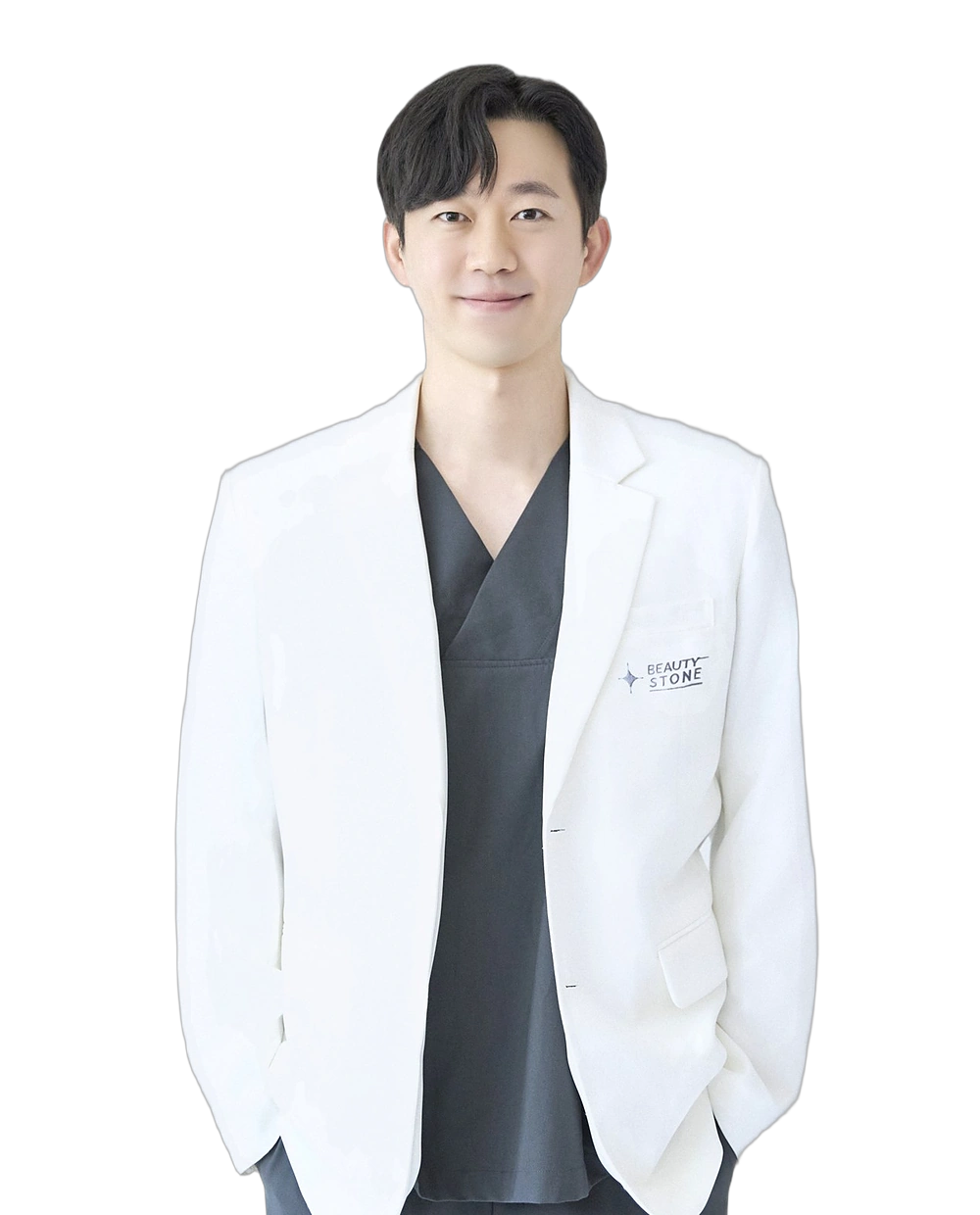
Kim Simon Jang-ju Head Physician
JANGJU KIM
Head Physician Kim Simon Jang-ju practices at STON Clinic, LOTTE HOTEL in Myeongdong (from December 1, 2026).
Career / Education
- Current) Head Physician (practicing at STON Clinic Myeongdong and Beautystone Clinic Hapjeong; Myeongdong from Dec 1, 2026)
- Graduated from Kyung Hee University College of Medicine
Comments